

The Place Where You Pause
Where writing pauses, and something deeper begins

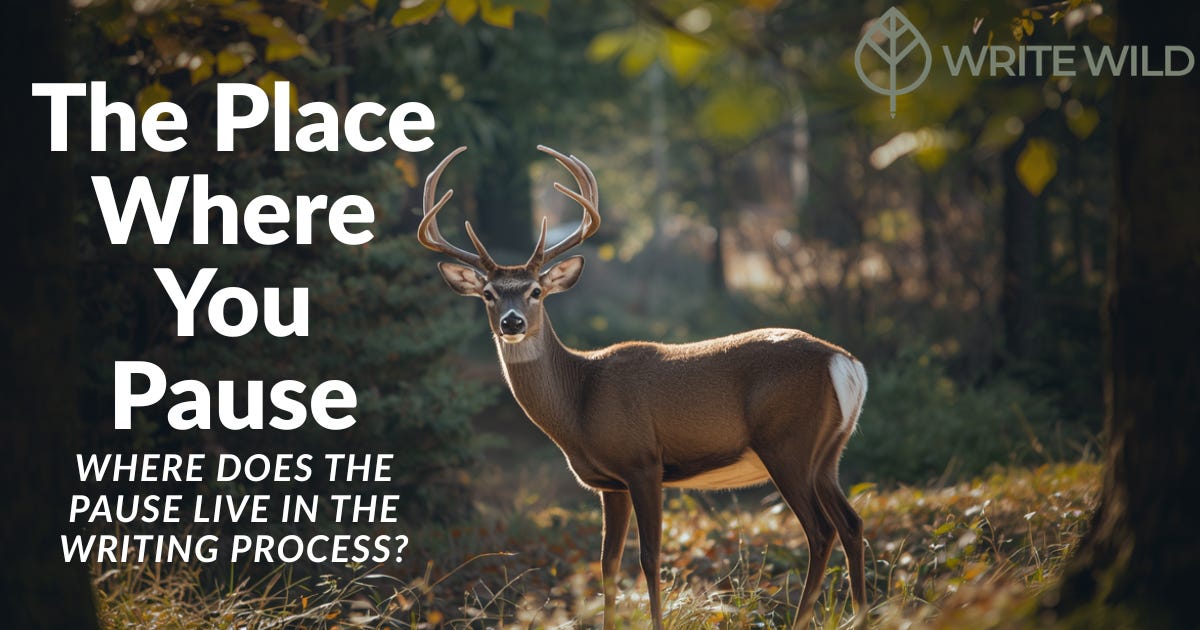
This week, I met a deer.
Not in the way you usually do, like a flicker at the edge of your vision, a sudden movement and gone.
This one didn’t leave.
She stood a short distance from me, still and alert, and I found myself doing the same. No reaching for my phone, no soft steps backwards. Just… stopping.
We watched each other.
And there was something in that moment that didn’t feel like chance. It felt like being caught inside something. It felt like stepping into a story that had already begun.
There’s a particular kind of stillness that isn’t empty.
It’s full of decision. You can feel it, if you stay long enough. It hums just under the surface.
A held breath.
I’ve been thinking about that moment all week because I recognise it. Not just in the woods.
In writing.
In the way a piece of work waits for you with a kind of steady presence. As if it knows you will come, eventually.
And you do come.
You open the document.
You read what you’ve written.
You stand at the edge of the next sentence.
And then—
you pause.
We tend to treat hesitation as something thin. Something to brush aside. A lack of confidence. A habit. A small flaw in an otherwise willing process. But what if it isn’t thin at all? What if it has depth? What if hesitation is not a delay, but a place?
If it is a place, then it has a shape.
You can approach it from different sides.
From above, it looks almost sensible. Measured. Careful. You are taking your time. You are thinking things through. From the side, it begins to look like something else. A circling. A returning to the same ground, wearing a path without moving forward. From underneath—this is where it gets more interesting—it can feel like protection. A hand, not pushing you back, but holding you just where you are.
Standing there with the deer, I had the strangest sense that neither of us was stuck.
We were both in that same held place.
Aware.
Waiting.
For the right movement.
This is where I think many writers quietly live, without naming it. In these small, precise moments where something asks a little more of you than you are used to giving. Perhaps a clearer decision or a truer sentence. Maybe an ending that won’t soften itself.
And you feel it.
You feel the point at which the work changes.
And you hover there.
I’ve noticed this in my own writing, and in the writers I work with. No one says, “I’m afraid to move forward here.”
Instead, it sounds like:
I’ll just read it again.
I’ll tweak this bit first.
I’ll come back to that tomorrow.
It looks reasonable. Even productive. But underneath it, something is holding.
So I’ve been asking myself:
What is hesitation asking for? Not what is it preventing—but what is it asking?
Is it asking for more time?
Sometimes.
But not always.
Is it asking for more skill?
Occasionally.
But often the skill is already there.
Or is it asking for a different kind of attention? The kind you don’t give when you’re trying to get through something. The kind that requires you to stay. To look. To notice exactly what is here, before you move.
When I stood with the deer, I wasn’t trying to do anything. I wasn’t trying to understand the moment or turn it into meaning. I was simply in it. And because of that, I could feel the exact point where it would shift. Not because I made anything happen. Because I stayed long enough to recognise it.
This is the part we miss. We think the work is in the doing. In the word count. The discipline. The forward motion. But there is another kind of work. Quieter. Less visible. The work of recognising where you are.
So let me ask you something, slowly.
Just to sit with.
Where, exactly, do you pause in your writing?
Not broadly.
Not “I’m struggling with my book.”
Where does the pause live?
And what changes, if you move from there? What shifts inside the work? Inside you?
And then—this is the question I’ve been turning over all week—
What if hesitation isn’t the absence of movement…
but the moment where the right movement hasn’t been recognised yet?
Eventually, the deer stepped away. No rush. No signal I could see. Just a quiet decision. And the moment was over. I carried on walking, but something had altered.
If you find yourself in that same held place, there’s nothing wrong with you. Feeling the silence. Feeling the stillness. Wondering what happened. You’re standing in a part of the process that asks for something more precise than effort.
I have four workshops coming up, each one meeting a different part of this. Not to push you through—but to help you see where you are, and what your next step actually is. I’ll launch them soon. If you like writing workshops that are specifically about writing and finishing a book, let me know in the comments. We can begin there, connecting and bringing your writing alive.
